The Day the Lake Was Grey
A guide's honest account of Humantay Lake under wet-season cloud: why the turquoise needs light, what a grey shore still offers, and how to plan for it.
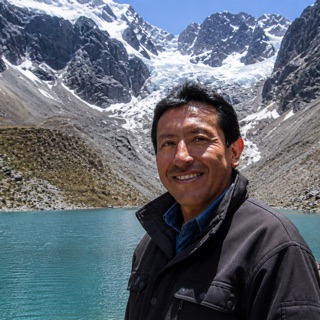 By Carlos Mamani, Humantay Lake tour guide & high-altitude specialist
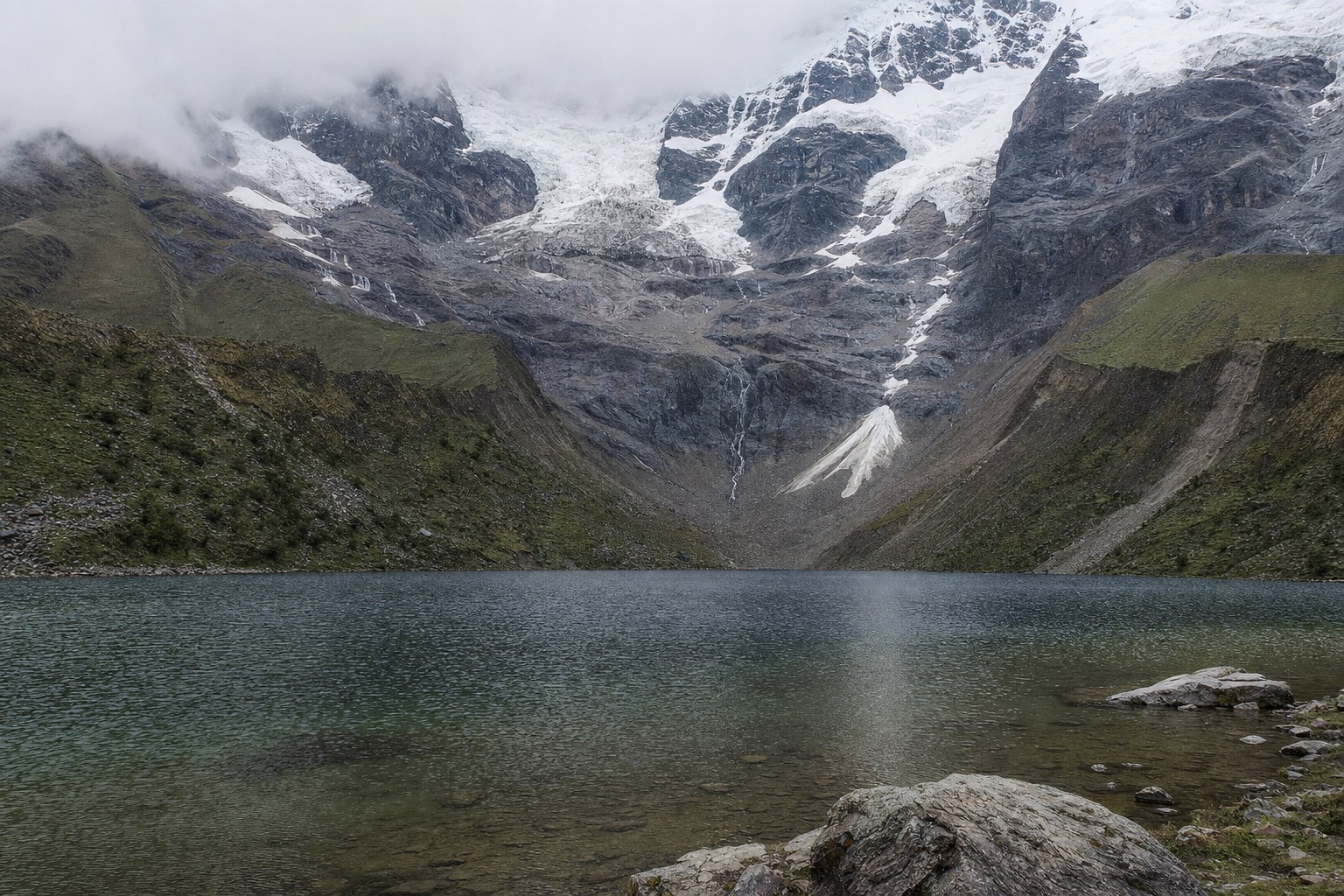
The cloud was sitting on the moraine before we even left Soraypampa. Not drifting past it, sitting on it, the way a cat sits on a chair it has decided to keep. It was a February morning two wet seasons ago, and I already knew, walking up the first switchback with eleven people behind me, that the lake at the top was not going to be turquoise. It was going to be the colour of wet slate. I guide this trail through both seasons, and the grey days are the ones that teach you the most about what this place actually is.
Booking choice: Explore the lake-and-glacier day even when turquoise is not the only goal. Check Humantay Lake dates
Affiliate recommendation · final price and options on GetYourGuide.The morning the colour stayed home
On heavily overcast wet-season days, Humantay Lake can look grey, steel blue, or dull green instead of turquoise. The water itself has not changed. What changes is the light: with thick cloud there is not enough direct sunlight for the suspended glacial sediment to scatter, so the famous colour simply does not switch on.
We reached the shore at about 9:40 that morning. The group went quiet in a way that was not the good kind of quiet. One woman from Belgium took out her phone, looked at the screen, looked at the water, and put the phone away. I have seen the lake blaze like a gemstone on a clear June morning, and I have seen it look like this, a flat pewter sheet with the glacier hidden two hundred metres up in the mist. Both are the same lake.
What surprised people, once the first disappointment passed, was how much was still happening. The waterfalls coming off the slopes were louder than in the dry months. Mist kept opening and closing across the far wall like a curtain being tested. Someone spotted a viscacha on the rocks. Grey days at 4,200 m have their own drama, it is just not the drama from the postcards.
I tell you this story first because nobody else will. The listings show the blue-day photos, and fair enough, that blue is genuine. But if you come between October and April you deserve to know both versions of this shore before you set a 3:30 AM alarm.
Why the turquoise needs light to happen
The colour comes from glacial rock flour, fine mineral particles that meltwater carries down from the Humantay glacier into the lake. Those particles scatter blue and green wavelengths of sunlight while absorbing the reds and yellows. No strong sunlight means little scattering, which is why cloud cover mutes the colour so dramatically.
This is standard physics for glacier-fed lakes, and Humantay Lake is a textbook example: a basin at roughly 4,200 m fed directly by ice melt off the peak above it. The glacier grinds rock into powder so fine it stays suspended in the water column instead of sinking. When sun hits that suspension, short blue-green wavelengths bounce back at your eyes and the longer warm wavelengths get absorbed. A good explainer on the mechanism is this piece on glacial flour lakes, which also makes a point I see confirmed on the trail every year: the colour tends to be most intense when fresh meltwater is actively feeding sediment into the lake.
There is a twist most visitors never hear. The wet season is also the melt season, so the sediment load in the water is high exactly when the skies are least cooperative. The turquoise machinery is fully loaded from December to March. It just needs the sun to pull the trigger, and in those months the sun is often busy elsewhere.
So the honest framing is not "wet season means a grey lake." It is "wet season means the colour is a coin flip that depends on the hour you arrive and the hole in the cloud." I have had January mornings where the overcast tore open for twenty minutes and the lake went from slate to electric green while people were mid-sandwich. Nobody who saw that complained about the mud on the way up.
It helps to match the sky you wake up to against the colour you are likely to get at the shore:
| Sky at the shore | Likely colour of the water | Why |
|---|---|---|
| Full clear sun | Turquoise to electric green | Strong light scatters off the suspended rock flour |
| Broken cloud with sun windows | Flips between slate and green as the sun comes and goes | The colour only switches on under direct light |
| Thin high overcast | Muted turquoise to dull green | Weak light means weak scattering |
| Thick low cloud sitting on the moraine | Grey to steel blue | Not enough direct sun to pull the blue-green back to your eyes |
What the rain gauge says about your odds
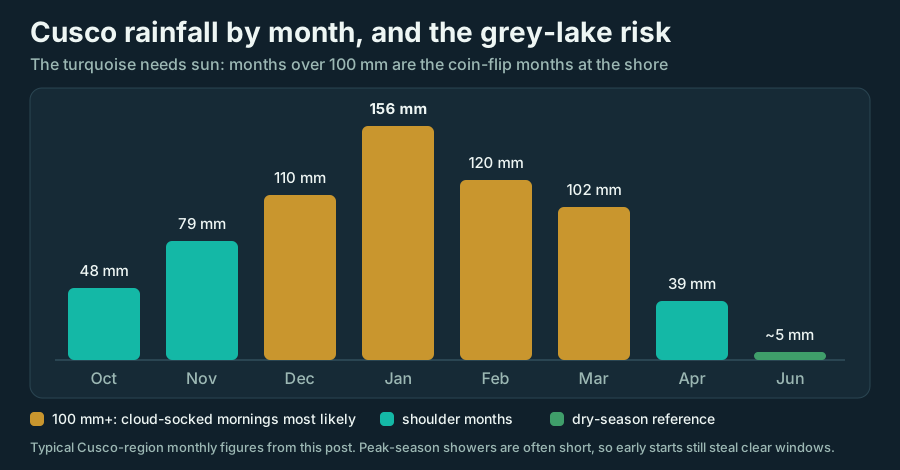
Cusco-region records show the wet season building from October, peaking around January at roughly 156 mm of rain for the month, then tapering through April. Showers fall almost daily in the peak months but are often short, which is why early starts still steal clear windows even in the rainiest weeks.
Numbers help here, because "rainy season" sounds absolute and it is not. These are the monthly rainfall figures for Cusco that I use when people ask me how bad their odds really are.
| Month | Typical rainfall (Cusco) | What it means on this trail |
|---|---|---|
| October | ~48 mm | Season warming up, many clear mornings still |
| November | ~79 mm | Building; pack real rain gear |
| December | ~110 mm | Daily shower risk, mud on the switchbacks |
| January | ~156 mm | The peak; cloud-socked shores most likely |
| February | ~120 mm | Still heavy; my grey-day story month |
| March | ~102 mm | Slowly easing, trail stays muddy |
| April | ~39 mm | Shoulder month, odds improve fast |
| June (reference) | ~5 mm | Dry-season baseline for comparison |
Two things jump out. First, January and February are a different sport from October or April, so "wet season" covers a huge range of risk. Second, even 156 mm spread across a month of mostly afternoon showers leaves plenty of dry mornings, which is one more reason the brutal pre-dawn pickup earns its keep. For a month-by-month breakdown of how this plays out at the lake itself, I keep a full weather-by-month guide that goes deeper than this story can.
The talk I give in the van before Mollepata
Somewhere on the dark highway past Limatambo I tell every wet-season group the same thing: the hike is guaranteed, the colour is not. Deciding together, out loud, that the day is about the mountain and not just the photo changes how people experience whatever the cloud decides to do.
The talk goes roughly like this. The lake has two faces. If we get sun, you will see the blue from the pictures and better. If we do not, you will see a moodier, wilder version that most Instagram visitors never witness, with waterfalls at full volume and mist doing things no photographer can schedule. Either way you will have climbed to 4,200 m in the Andes before lunch, and that stays true in any weather.
Then I give them the practical version of hope: mountain weather here moves fast. Cloud that looks welded to the ridge at 8 AM can be gone by 9:30. We watch, we wait a little at the shore, we drink coca tea when we are back down. I have watched full cloud cover break apart in the time it took a group to eat their snacks, and I have also stood there forty minutes while it thickened. You are dealing with an atmosphere, not a light switch.
Here is how the two versions of the same morning actually compare, from someone who has stood through many of both:
| At the shore | Clear morning | Cloud-socked morning |
|---|---|---|
| Water colour | Turquoise to electric green | Slate grey to steel blue |
| The glacier | Full wall in view | Appears in gaps, often hidden |
| Waterfalls | Modest flow | Loud, full, everywhere |
| Photos | The postcard shot | Moody, misty, honestly striking |
| Crowds | Larger, longer stays | Thinner, people leave sooner |
| Temperature feel | Sun-warmed, burns fast | Raw and damp, wind bites |
What a grey shore still gives you
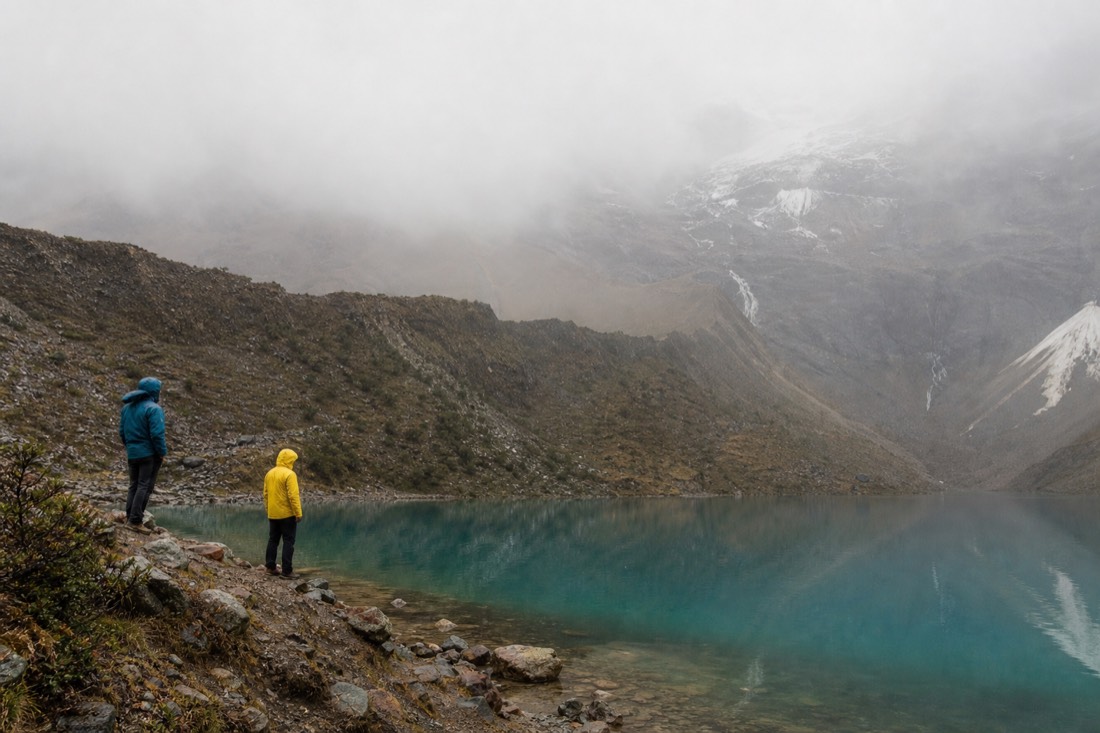
A grey day still delivers the full hike, the glacier valley, the waterfalls at their loudest, thinner crowds, and a version of the Andes that feels genuinely wild. What it takes away is one specific photograph. Whether that trade ruins the day is mostly a decision you make in advance.
That February group I mentioned surprised me. After the first flat ten minutes, two of them walked the shoreline to the far cairns and came back grinning. The Belgian woman got a shot of mist peeling off the water that she later told me she liked more than any blue-lake picture she had seen. The lake sat still and dark like something out of a colder, older story, and Apu Humantay above it felt more present for being hidden. There is a reason the mountain is sacred to communities here, and grey weather makes that easier to feel, not harder. I wrote more about the wet months generally in rainy season at Humantay, and about getting the shot when the colour does appear in photographing the turquoise.
Build a weather buffer into your Cusco days
If seeing the colour matters to you, do not book the lake for your only free morning. Put it early in your Cusco stay with at least one spare day behind it, so you have another day to consider; changes inside the cancellation deadline can still cost money.
This is the single most useful planning move for a wet-season trip, and almost nobody does it. Most people wedge the lake between a Machu Picchu day and a flight. Then the forecast turns, and they have no room to move.
Here is the shape of a Cusco stay that carries a real buffer:
| Day | Plan | Why it works |
|---|---|---|
| 1 | Arrive Cusco (~3,400 m), walk slowly, rest | Acclimatization starts, no exertion |
| 2 | Easy valley sightseeing at lower altitude | Second acclimatization day before 4,200 m |
| 3 | First lake attempt if the forecast looks fair | Earliest sensible slot for the big altitude |
| 4 | Buffer: reshuffle day, museums, San Blas | Absorbs a cancelled or moved lake day |
| 5 | Second lake window or onward travel | The buffer either got used or got enjoyed |
One more honest note on the buffer plan. It also protects you from your own body, not just the sky. The two quiet days in front matter because this hike starts at roughly 3,850 m and tops out around 4,200 m, and altitude illness does not care about your schedule. The CDC's high-elevation travel guidance is blunt about giving yourself time before exertion at these heights, and I see the difference in groups every single week.
The lake was grey that whole February morning. Nobody got the postcard. On the walk down, though, the cloud lifted off Soraypampa and the valley below us turned gold for about five minutes, and eleven phones came out at once. The mountains pay you back. Just not always in the currency you ordered.
Your next step
Choose your day from Cusco
Match the trip to your plans
General recommendation · confirm your own requirements
Humantay Lake with breakfast and buffet lunch
Have a date in mind? Let one booking cover the ride to Soraypampa, your guide and both meals. Check your departure before arranging the rest of your trip.
12–13.5 hours · Transport, English/Spanish guide, breakfast and buffet lunch, first aid and emergency oxygen. Entrance fee and optional horse are extra, paid locally in cash.
Choose the historic-center pickup option and confirm your hotel; other options use a meeting point. Downtown Cusco drop-off.
A steep high-altitude hike. Not suitable for pregnancy, mobility or respiratory limitations, vertigo or low fitness. A horse does not remove the walking or altitude requirements. Free cancellation until 24 hours before departure.
Affiliate links: we may earn a commission if you book, at no extra cost to you.